Workflow tools
Microduck - microduck robot
A $399 duck-shaped walking robot from Hugging Face and Pollen Robotics that developers can program and train with reinforcement learning.
Workflow tools
A $399 duck-shaped walking robot from Hugging Face and Pollen Robotics that developers can program and train with reinforcement learning.
Product insights
Brings reinforcement-learning robotics to a desk-sized, $399 robot that is built to move, fall, and get back up, so you can train real locomotion without lab hardware.
Legged robots for learning and research usually cost thousands of dollars and break easily, which makes hands-on reinforcement-learning experiments out of reach for most developers.
AI and robotics developers, students, educators, and hobbyists who want to experiment with locomotion, sim-to-real training, and physical AI.
$399 per robot, including a game controller, battery, and USB cable. Pre-orders are open on the Pollen Robotics store for North America and Europe, with shipping planned before Christmas 2026. The software and SDK are free.
Microduck is a programmable, duck-shaped walking robot from Hugging Face and Pollen Robotics. It is designed for physical AI: you can play with it out of the box or train new movements in simulation with reinforcement learning and run them on the real robot.
Order Microduck from the Pollen Robotics store. It ships with a game controller, a rechargeable battery, and a USB cable.
Use the controller to walk it around, trigger its trained moves, or have it follow a laser pointer, with no code required.
Try the browser simulator on Hugging Face, train a policy with the open-source RL stack, then run it on the robot through the Rust SDK.
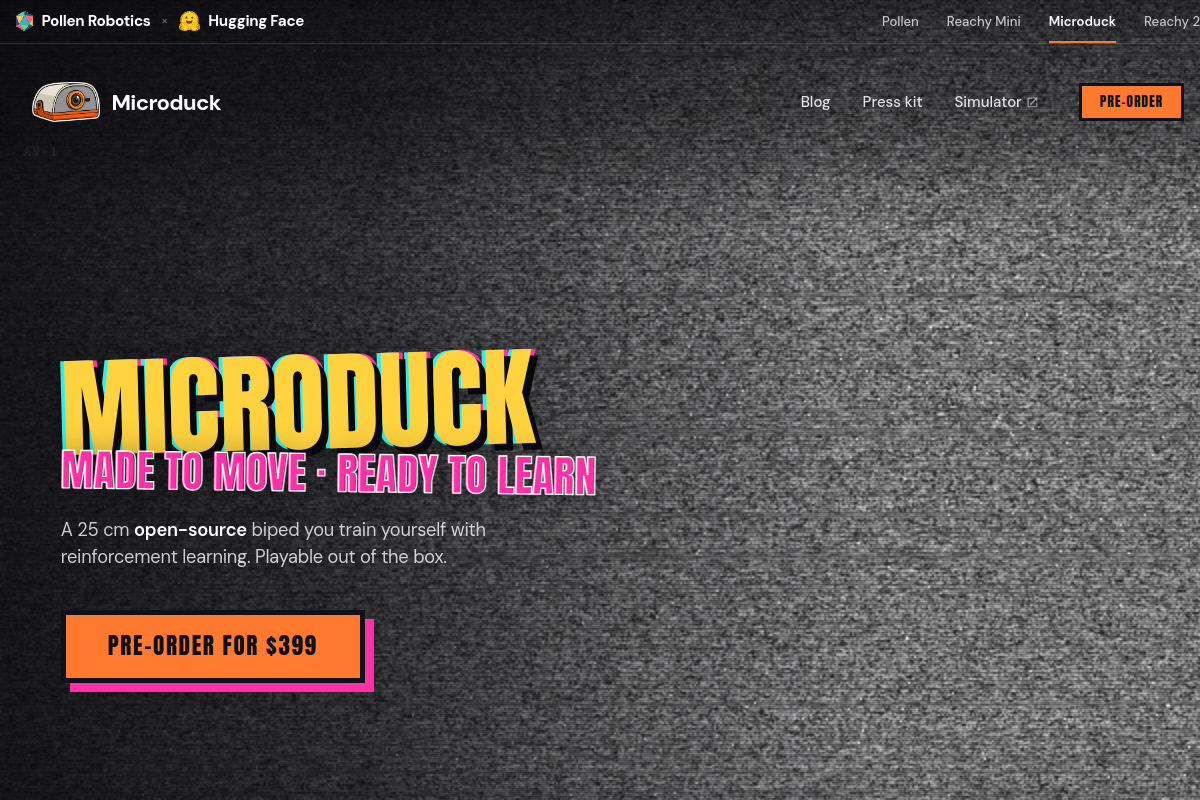
Microduck is a 25 cm, duck-shaped biped robot from Pollen Robotics and Hugging Face. It walks, picks up small objects with its beak, and can be programmed and trained with reinforcement learning.
Microduck costs $399. Pre-orders are open on the Pollen Robotics store for North America and Europe.
Pollen Robotics plans to start delivering Microduck before Christmas 2026.
Its Rust software stack, SDK, and Python simulation and reinforcement-learning tools are open source on GitHub. Pollen has not described the hardware as open-source hardware.
Official website snapshot
pollen-robotics.com
Microduck is a small duck-like biped robot from Pollen Robotics, the French robotics company owned by Hugging Face. Announced on August 27, 2026 at $399, it stands about 25 cm tall, weighs under 800 g, and has 15 motors across its legs, neck, and head, plus an articulated beak that can pick up small objects. It walks, sits, gets back up after falls, and even roller-skates. It ships with trained moves and a game controller, while developers get an open-source Rust SDK, a browser simulator, and a reinforcement-learning stack to teach it new behaviors. Pollen reported more than 10,000 pre-orders in its first week, with deliveries planned before Christmas 2026.